Showing posts with label contemporary. Show all posts

Wednesday, 1 December 2010

Terry Pratchett’s Unseen Academicals


It’s hard to pinpoint exactly where I first became aware of Terry Pratchett – sorry, SIR Terry these days. The truth is it was with my brother’s copy of Only You Can Save Mankind, and him chuckling over the captain having no choice but to say ‘You are severely reprimanded’; I remember at age 8 or so not understanding at all what he found so amusing. I read the book, but ‘Terry Pratchett’ was just a name, and I still knew nothing of Discworld. When I was ten, I was going through a period of loving Marvel Comics, and in an attempt to steer me back towards the literary, as well as her own favourites, Mum bought me a graphic novel of The Hobbit – which was bundled with the excellent comic adaptation of Mort. This fired the imagination, and I borrowed my first Discworld novel – Men at Arms – and proceeded to devour every single Pratchett book ever written, including the more obscure – and often terrible – books: Strata; The Unadulterated Cat and Eric, for example. Well…except for the maps and plays.

Pratchett remains a favourite author, and of course my heart goes out to him whenever I hear about his Alzheimer’s. Some of his books I can reread again and again and always love. On the other hand, I’ve not been particularly enamoured of any Discworld book: Monstrous Regiment was an entire rather dull book for the sake of one joke obvious from the start; the Lipwig books, about introducing familiar institutions from our world into that of the Disc, satisfy but feel like formulaic rehashes of books like Guards! Guards! and Moving Pictures; Thud! ultimately meandered without a strong plot or ending, and even the Tiffany Aching books don’t quite live up to their promise.

So I wasn’t expecting much of Unseen Academicals, in which football takes centre-stage. From the looks of the cover it would be another Rincewind book, with the staff of the Unseen University bumbling about and probably foiling some contrived magical disaster. So it was quite pleasing to discover that I was completely wrong about that. Because while football is a large chunk of this book, it is only one piece, and the much large slice of the, uh, pie is taken by Glenda, probably my favourite Discworld character to be introduced since Otto – and far less silly.
The UU discovers that it is required by ancient statute to play a game of football, which is a rather terrifying and anarchic game. So they set about reforming it into something playable. Hopelessly out-of-touch with the working people, though, they need help, and those roped into doing so end up being the workers of the night kitchen, including Trevor Likely, the son of a famed old-style footballer who has vowed never to play, headstrong everywoman Glenda and her beautiful but thick best friend Julia, plus the rather peculiar Mr. Nutt, who looks like a big goblin but speaks like an orator.

Nutt is the key character to the piece, his innate abilities facilitating much of the action and also saying a few things about prejudice. Trev and Jules provide the romance, cheesy uplifting moments and more or less for the sole purpose of some Posh and Becks references, allow for a fun side-plot about fashion and celebrity that also introduces some great new characters. But Glenda is the real protagonist of the story, a plain and dumpy girl who isn’t too smart but nonetheless has great insight and determination and generally can sort out the world just by seeing the way it truly works. She’s a character it’s very easy to sympathise with, and it’s very hard not to be on her side.

I was fully prepared to think that Unseen Academicals was where Pterry jumped the shark. But in fact, even though there is no great crisis, nor any evil to overcome, the novel turns out to be perhaps the most mature and intelligent of recent months. Well worth reading!

Friday, 1 October 2010

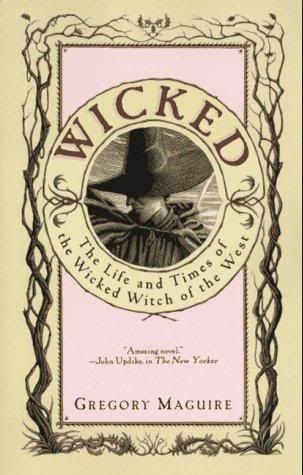
Wicked, by Gregory Maguire


The desire to take established characters and puppeteer them your own way has a long history – the Ancient Greeks told the same stories of their pantheon in many and varied ways, much of the Bible and several of the Gnostic Gospels are different takes on basic frameworks, Chaucer, Shakespeare and Milton put their own spins on popular yarns, and in the last century, there’s been a great market for (often trashy) sequels to classic stories, taking well-loved characters and putting them in a new setting. Despite the issues of copyright, there’s a huge boom in fanfiction writing on the internet, where a young writer’s narcissism can be satisfied almost instantly by peer reviews. Often, a clever online writer will take a myth or legend, a children’s classic or fairy story, and put it through a revisionist adult lens; on a grander scale, that is precisely what Maguire has done with Wicked.

Thanks mostly to the monstrous success of the movie, almost every Western child knows the story of The Wizard of Oz, and young Dorothy’s fortuitous, slightly random victory over the Wicked Witch of the West. And the world of Oz is familiar as a simplistic fairytale country, with broad characters, fantastical creatures and the kind of mildly scary peril that a young Kansas girl can get out of through luck or the help of friendly creatures. So Maguire uproots it all, makes the world a very real, very adult place with socio-political tensions, candid sex, anarchy and government-sanctioned torture. In this setting, he tells the story of that Wicked Witch, here named Elphaba (after L. Frank Baum), making her a prickly but sympathetic central character while showing us how she came to be where she was when she crosses path with the young girl from another world.

It’s a very nice concept, and the concept is what makes the book a success, I feel. I suspect it’s the kind of book far fewer people have finished than begun, and rather fear going to see the musical, knowing that it would be a painfully sanitised version of this very adult book – and cringe when I hear The Vinkus has been whitewashed to make Fiyero a more saleable leading man. And while I respect Maguire for his integrity in making this book about witches, magic and flying monkeys a serious, weighty and provocative piece (though whoever sanctioned ‘reading group material’ at the end of the book, where we are matter-of-factly informed Wicked is ‘an epic, treading similar ground as Greek and Shakespearean Tragedies’ or suchlike, needs a slap and a literary education, despite my own allusions to them above), with a detailed and very human character study at its centre, I do find myself questioning whether or not it had to be quite so dull.

We begin with Elphaba’s birth, child of a pious clergyman and a bored wife. Elphaba comes out green, and shocks everyone with strange behaviour, while a new man in the life of the parents inevitably sparks the warming flame of adultery. A moderately interesting family drama, ultimately totally unsatisfying. Then come Elphaba’s university years, full of irritatingly pretentious discourse as Elphaba becomes a supporter of the rights of sapient Animals, debates the purpose of society with the air-headed good-witch-to-be, Galinda, and religion with her devout sister Nessarose. She rebels against authority, and nothing much happens. Her adult life as an anarchist is more interesting, but cut short to leave a central event mysterious. After that, she meanders about fretting about her past, proving a thorn in the side of the Wizard by doing little more then existing far from the Emerald City with a tacked-on birthright, until the crucial moment comes – Dorothy arrives. All this build-up – does it pay off?

Well, sadly, no. The worst part of the book is its climax. It’s almost as if Maguire has lost interest. Only the most essential concessions are made to the original scenario, and the final scenes are undercut by extremely lame underplayed humour (Liir, Elphaba’s son, falls over trying to look stately, the senile old nanny starts eating a candle thinking it’s cheese), until finally the Witch grows violent in a most unconvincing way.

Ultimately, it feels like the very hook of the concept, that it’s a re-imagining of Oz, seems like an encumbrance, and doesn’t quite work. Elphaba is a good character, changeable and logical enough to be believed in, but she doesn’t tie in enough with the original flat character for it to make sense, and nor are her actions enough like those we know from the movie or the original book. Oz isn’t Oz, it’s just got a Yellow Brick Road and a Wizard ruling it. Yes, perhaps that’s the point of a re-imagining, but it more or less feels like this should have been an entirely different story, and has only latched on to Oz to make itself more accessible (admittedly a marketing trick that worked), which makes the whole concept hollow and brittle.

Also, I had problems with Maguire’s prose style. The man is a very gifted writer, and some of his extended images are absolutely beautiful, but occasionally, along come comparisons that just bewilder. How does an emotion simmer like dust in a sunbeam? I know that he was trying to obscure the colour of the magic slippers because Baum fans want them silver and the movie’s devotees are expecting ruby, but to answer that by just lobbing random colour-based similes at us (‘They sparkled like yellow diamonds, and embers of blood, and thorny stars’ – erm, how’s that, then?) is just confusing. And I found myself pausing, the mood broken, at certain choices of word; it’s well and good (and appreciated, for I was impressed!) flexing your vocabulary muscles with words like ‘verdigrisian’, and yes, it’s daft to argue about the language of a magical world, but should there really be words of markedly, recently French derivation, or German, or Native American, in Oz? It just takes you out of the moment to wonder about it, and that annoyed me. Would the inhabitants of this simple kingdom really know what an aquarium looks like?

Minor quibbles, but minor quibbles add up, and without a really gripping story, with a constant feeling of the story dragging, lack of substance unable to support its weightiness, and with too many details purposely left unsaid for the sake of mystery, I fear that this is an experiment that didn’t work.

Sad, though, that Maguire will most likely be remembered for the musical, not for his skill as a writer.